The following is from Susan Broome, a CBF national Coordinating Council member and associate professor of library services at Mercer University in Macon, Ga. This is the text of a speech she gave at the CBF of Georgia Fall Meeting Nov. 7.

The chalice dates from 1868, when the first Baptist church in Russia was constituted in Tbilisi.
In mid-February while conducting research for his dissertation at Oxford University, Malkhaz Songulashvili came across the name of Louie D. Newton, a prominent Georgia minister, who visited the USSR in 1946 and met both religious and political leaders of the country. Dr. Newton had been a member of a Russian War Relief delegation of Americans who were invited by the Soviet government to inspect the uses of gifts for relief from America; to inspect medical, educational, and cultural institutions; and to confer with Soviet officials. Malkhaz wondered if there were archival materials related to this trip, and his query came to me and several others working in Baptist history in the United States.
I answered his email immediately, telling him that Dr. Newton’s diary of this trip was located in the archives of Mercer University. I offered to transcribe the diary, search for other files in our archives, and search for related materials at Druid Hills Baptist Church in Atlanta—and I mentioned some photos I had seen of a chalice that was presented to Dr. Newton from the Baptists in Russia at the end of his visit. Malkhaz responded, saying that he was particularly interested in Newton’s trip to Tbilisi, Georgia (his own hometown), and any documentation of a possible meeting between Newton and General Secretary of the Communist Party Joseph Stalin. This was getting really interesting!
A search of correspondence files provided enough information to make it seem very likely that Dr. Newton did have a personal encounter with Stalin, presenting him with a Bible and two pipes. Malkhaz commented that this was probably the first and last meeting Stalin ever had with a Baptist minister. My chance encounter with one of Louie Newton’s grandsons in late September confirmed that a face-to-face meeting actually did take place.
But, back to the chalice—when I read of the chalice and saw photographs of a very handsome vessel, I hoped that I could locate it, but I was leery. It had been almost 65 years since its presentation. It was not part of our library’s holdings of Dr. Newton’s personal papers, nor at Druid Hills. It was not at the American Baptist Historical Society’s archives in Atlanta, nor at the Southern Baptist Historical Library and Archives in Nashville. The thought of having to tell Malkhaz that it could not be located weighed heavily on me, particularly since it had originally been used in Tbilisi at his own church in 1868.
In mid-March one of my faculty colleagues mentioned that she had heard the word “chalice” used in a taped interview with Dr. Kirby Godsey, then-president of Mercer University, that she was cataloging. She didn’t know the details of that part of the interview, but she knew I had been in search of a chalice—and this is not a word that Baptists use very often! How odd, I thought. Why would he mention a chalice unless he had seen one?
A few nights later, just as I was about to fall asleep, I suddenly had a vision of an anteroom in Newton Chapel on our campus. I had a vague memory of photos on the wall related to Dr. Newton, since the chapel was named for him a number of years ago. The room isn’t always open, but I knew where it was. Because of an out-of-town meeting, I had to wait until the end of the next day to walk over to the chapel, try the doorknob to the room, discover it unlocked, turn on the light, and find the chalice right in front of me as the centerpiece of a display of photos, printed documents, and other objects (including pipes that belonged to Dr. Newton—which were a clue of why he presented pipes as gifts to Joseph Stalin!). It was March 25.
Since then I have seen documents that describe the chalice as 14th or 17th century Florentine. Either way, it is very old. We know that it dates from 1868, when the first Baptist church in Russia was constituted in Tbilisi. It was in 1868 that a rich merchant, Mr. Nikita Veronin, who had been baptized in August of 1867, purchased and presented the chalice to this new church. What began as a sheet of silver was hammered into shape, assembled, plated with gold, and then hand-engraved with a Latin phrase that circles it, inviting Christian believers to “Drink ye all of it.”
From what I have read [and Malkhaz may know better], it appears that the chalice was used in observance of the Lord’s Supper at the church in Tiblisi until 1928, at which time a Georgian minister was called to pastor the First Baptist Church, Moscow, the largest Baptist church in the Soviet Union. The Baptists of Tbilisi asked him to accept the chalice as an expression of their love for him and Baptists of Moscow and all of Russia. So this chalice had come to be a symbol of fellowship amongst Russian Baptists and was their most cherished possession.
“Quite the most beautiful communion chalice” Dr. Newton had ever seen was presented to him by Pastor M. A. Orlov of the First Baptist Church, Moscow, on Thursday evening, August 8, 1946, after Dr. Newton had preached his last sermon in Russia, and after the chalice had been used in observance of the Lord’s Supper by the large congregation that overflowed the meeting house. Dr. Newton called it “the most precious treasure of the Baptists in Russia.”
The gift of this chalice was ever present in Dr. Newton’s mind, as he spoke and wrote of Baptists in Russia and in Georgia following his trip, as he showed the chalice at numbers of large Baptist gatherings, and even as he provided materials for a display in his honor on the campus of his alma mater, Mercer University. He was honored and humbled by such a gift. Malkhaz has seen and held this chalice for the first time this weekend. It has been more than 80 years since it left Tbilisi and almost 65 years since it left Moscow. At every turn it has been well preserved by those who received it.
Images of religious objects, events, and individuals are very important to Baptists in Georgia. The Beteli Center in Tbilisi provides a school of iconography to preserve this ancient Christian art form. Tonight the Cooperative Baptist Fellowship of Georgia wishes to provide Malkhaz and the Evangelical Baptist Church of Georgia with a life-sized photographic reproduction of the Georgian chalice as a model from which another icon may be created. Georgians living now have never seen this sacred vessel, and we hope that this image will serve as a reminder of the commitment that Georgians made in constituting and sustaining a Baptist church in their land since 1868 and as a testament to the Georgia-to-Georgia partnership that has been renewed in this present day.
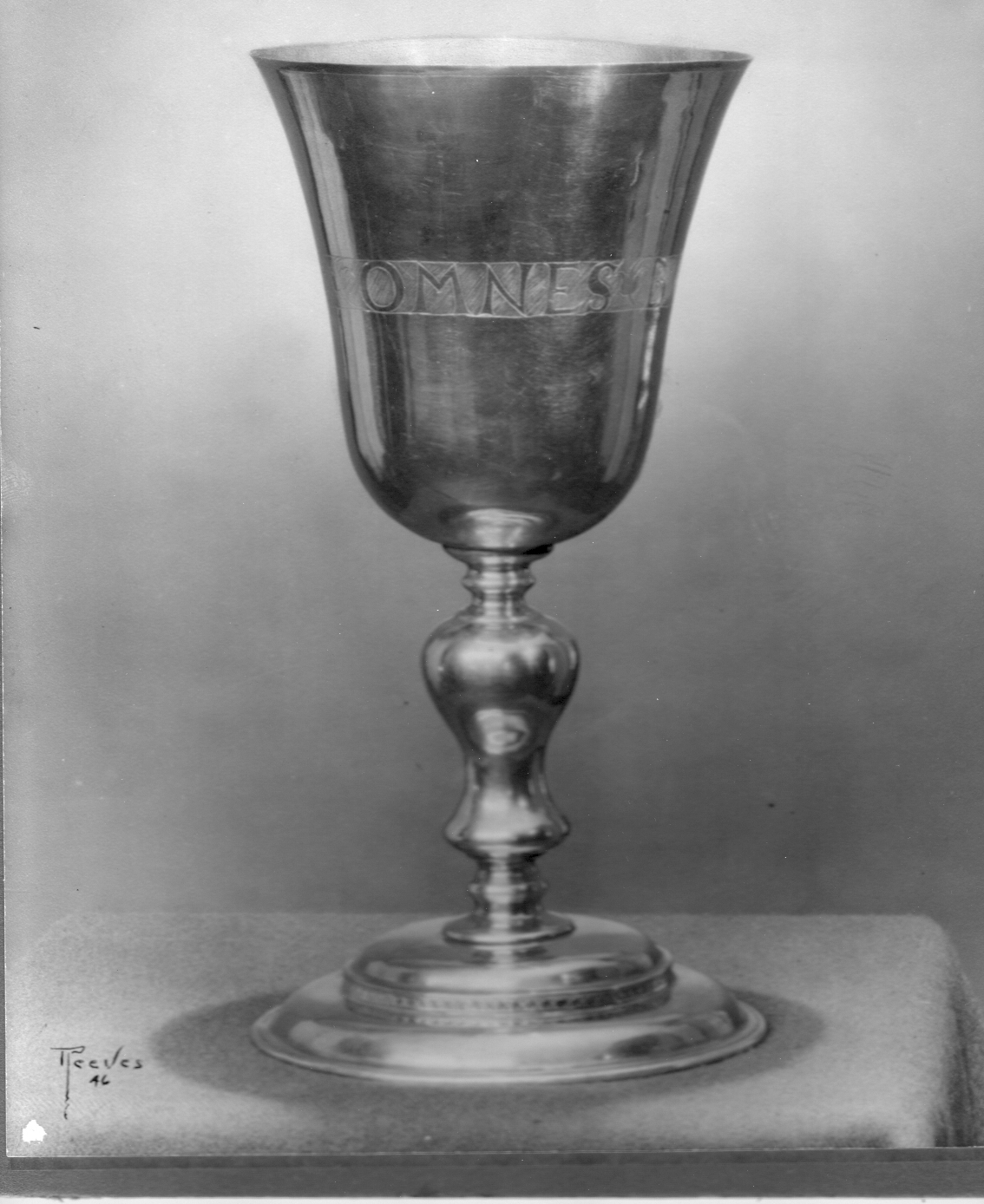
The chalice dates from 1868, when the first Baptist church in Russia was constituted in Tbilisi.