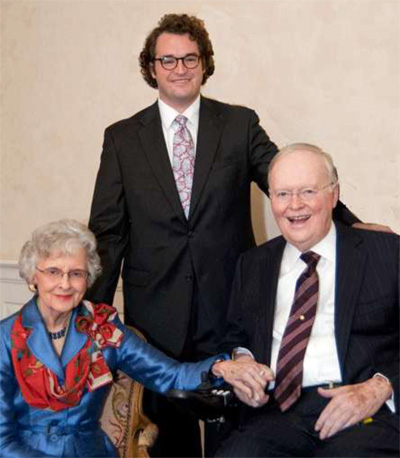
Dr. William E. Hull, right, shares his journey with ALS.
Dr. William E. Hull is a lifelong Baptist who has shaped many lives through pastorates in Alabama, Kentucky and Louisiana and academic positions at The Southern Baptist Theological Seminary, Baptist Theological Seminary in Switzerland, Louisiana State University, Nigerian Baptist Theological Seminary and Samford University. He now serves as Theologian in Residence at Mountain Brook Baptist Church in Birmingham where he and his wife, Wylodine, have been members since 1991.
Dr. Hull has graciously agreed to share with the Cooperative Baptist Fellowship Community his story of living with Amyotrophic lateral sclerosis (ALS). Also known as Lou Gehrig’s disease, ALS is a disease of the nerve cells in the brain and spinal cord that control voluntary muscle movement.
His reflections will be posted to the CBF blog in three parts this week. The entire document can be downloaded.
Present
ALS follows no predictable path in its conquest of the body. For me, it began at the bottom and is traveling upward, while for others it begins at the top and travels downward. After three years, the scourge has done about all the damage it can to my legs and feet, so let us see what it is now doing to my abdomen and arms.
Again the story is one of silent surprises. For example I never knew that muscles in the torso help to hold the stomach in place. As ALS weakens those restraints, the internal organs that they support may tend to protrude more than usual. During my adult life, my weight varied between 175-180 pounds, my waistline between 36-38 inches. With the onset of ALS, my weight fell to 158 pounds before I regained much of it back by taking nutritional supplements. And yet, when at that lowest weight, my waist expanded, by careful tape measure while sitting in the wheelchair, to a whopping 48 inches. Why do I weary you with these statistical details? Because they explain how my entire wardrobe, carefully collected over many years, was suddenly rendered obsolete. I can no longer button a single coat or fasten a single pair of pants in my closet and no tailor can do anything about it. Call it collateral damage if you wish. I told you that ALS was sneaky!
Speaking of collateral damage, this may be a good place to comment on the presence of pain that figures so prominently in most life-threatening diseases. Except for an occasional tremor, ALS does not announce its presence by torturing the body. But the condition that it leaves behind may contribute indirectly to an assortment of ills. I now suffer regularly from bladder spasms (think: abdomen-in-agony) and peripheral neuropathy (think: feet-on-fire). As if this were not enough, there is the insatiable itching caused primarily by sitting in one chair in one position for sixteen hours every day of my life. So: stabbing pain alternates with frantic scratching – does God have a sense of humor, or what?
Not to give away the plot prematurely, it is when ALS reaches the throat that the final battle is joined. To prepare for that showdown, I learned to utilize two new procedures: (1) To assist in eating, a feeding tube was inserted directly into my stomach through which I receive all of my medications in liquid form. Formerly I swallowed some twenty-five pills a day, but this posed too many hazards of chocking and ending up with a pill in my lungs. I also ingest through the tube a medical food supplementing the table food that I continue to eat and enjoy. When I can no longer swallow, increased tube feeding will be able to provide my body with balanced nutrition for an indefinite period. (2) To assist in breathing, I am now tethered to an oxygen tube for most of my waking hours. In addition, my pulmonologist is guiding some deep breathing exercises calculated to strengthen and utilize the full capacity of my lungs, especially the lower section that can get crowded out by nearby organs. Whenever I sleep, whether at night or during a daytime nap, I wear a face mask connected by a hose to a Bipap machine that supplies the needed amount of air on a consistent basis. Anyone being treated for sleep apnea will be familiar with this arrangement.
The most common thing that friends say to me these days is, “you look good.” While I deeply appreciate this word of encouragement, I must take it with a grain of salt.
Appearances can be deceiving with ALS. For example, you always see me in shirts with long sleeves, even during this long hot summer, because my arms have withered away to the size of a broomstick. Then there is the slowing pace of life. It now takes me three times as long to do one-third as much as I once did. For example, whereas I used to get ready for church in an hour (7:00-8:00), it now takes more than three hours (5:15-8:30), even with the help of the fastest caregiver in town! The most heartbreaking challenge that I am facing now is the loss of my ability to communicate. I can barely talk, write, or type, and soon these capacities will be gone. Look for me to be experimenting with AAC (augmentative alternative communication) devices such as DynaVox and iPad2 with apps.
Brooding over these physical frustrations is the major plot of ALS, namely, to condemn me to a relentless, remorseless decline from skillfulness to clumsiness to helplessness to uselessness that cannot be reversed or stopped. Right now this is already happening to bits and pieces of my body, but eventually this hit-and-run damage will coalesce and my entire fleshly framework will become dysfunctional. What will I do then?
The Apostle Paul often found himself battling so many foes that he felt impotent to respond. After cataloging the calamities that had engulfed him, he described his condition as one of “weakness” (2 Cor. 12:7-10) or even “death” (2 Cor. 4:8-12). Reflecting on why he had been able to transcend these severe limitations, Paul concluded that “by the grace of God I am what I am, and his grace toward me was not in vain” (1 Cor. 15:10). Even though ALS often leaves me so weak that I feel dead, it cannot destroy “what I am” – my being, my selfhood, my spirit. And by God’s amazing grace I enjoy a wonderful life. God has given me a wonderful wife, wonderful family, wonderful friends, wonderful church, wonderful physicians and caregivers. I have done nothing to deserve such blessings. Rather, they are all the result of God’s unmerited favor. When I compare what others have done for me with what I have done for them, my contributions are as nothing. I say this, not to blame ALS, but to thank ALS for making God’s grace so clear and dear to me.